"A pint of plain is your only man." — Flann O'Brien, At Swim-Two-Birds
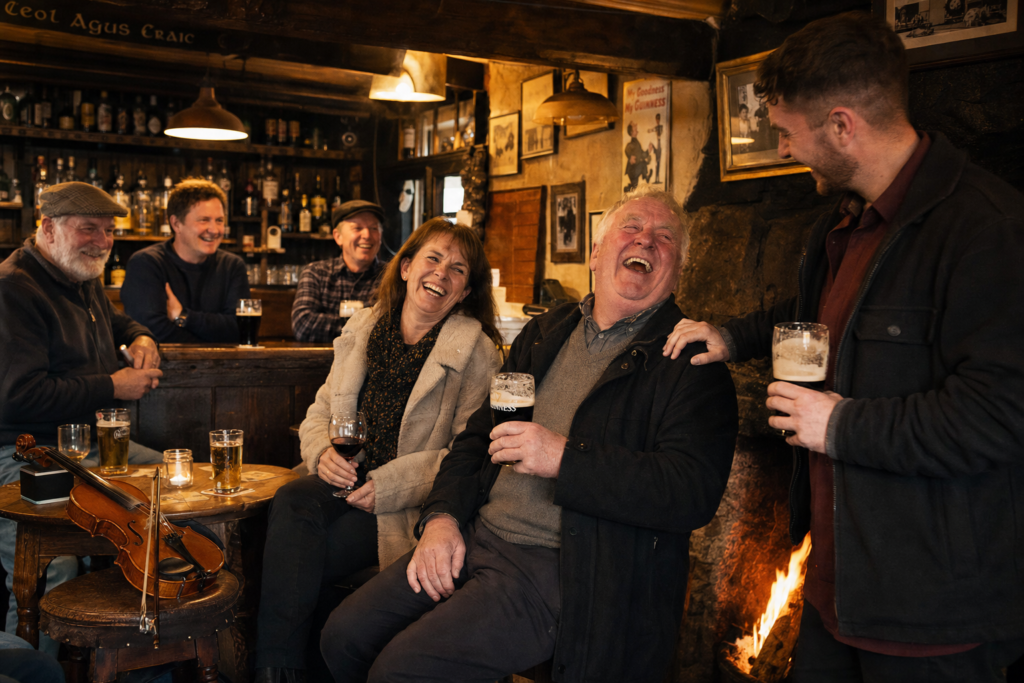
O'Brien wrote that with his tongue firmly in his cheek. But strip away the mock-heroics and there's a plain truth underneath: the pub has always been more than a place to buy a drink in this country. It's where the parish meets, where the news travels, where the music starts. And right now we are losing them at a rate that should alarm anyone who cares about rural Ireland.
This isn't publican folklore. Independent analysis by Anthony Foley, Associate Professor Emeritus of Economics at DCU Business School, found that Ireland had 8,617 pubs in 2005 and 6,498 by 2024 — a loss of 2,119 pubs, down almost a quarter. And it's getting worse, not better: the average had been around 112 closures a year, but in the most recent stretch (2019–2024) that rose to roughly 128 a year, with a further 600 to 1,000 closures projected over the coming decade.
The pain is not spread evenly. Dublin has barely moved (down 1.7%). The rest of the country is down nearly 27%, with Limerick, Offaly and Cork hardest hit. This is a rural problem, plain and simple — and the CSO's own figures back it up, with bar sales the steepest-falling part of the entire retail sector in the year to March 2025.
To its credit, the Vintners' Federation of Ireland isn't just complaining — it has put forward a concrete proposal: an On-Trade Sustainability Scheme. It borrows a model the Government already uses for film, television and digital gaming — a tax credit, here tied to verified draught purchases and capped at €20,000 per premises per year, offset against tax or paid as cash where there isn't enough tax to cover it.
(Source: Opening Statement by Pat Crotty, CEO, Vintners' Federation of Ireland, to the Joint Committee on Enterprise, Tourism & Employment, 17 June 2026.)
The rural pub is social infrastructure. It does the quiet work of holding a community together — the funeral afters, the match on the telly, the lift home arranged at the bar, the only warm room some people will sit in all week. You don't see that on a balance sheet, which is precisely why the market won't protect it on its own.
And it earns its keep with the visitor too. When overseas holidaymakers were asked which experiences influenced their decision to come here, "an Irish pub" ranked first, at 80% — ahead of our heritage towns, our castles, even the Cliffs of Moher (Fáilte Ireland Visitor Attitudes Survey, 2013). Food and drink is now the single biggest slice of what tourists spend here. The pub isn't a sideshow to Irish tourism; for a great many visitors, it is the experience.
I'll confess a personal interest. I've spent more hours in these places than I should ever own up to — and I hope to spend a good many more. Sláinte.
Ireland wouldn't be alone in acting. Across Europe the same instinct has taken hold: France has its "1000 Cafés" programme reopening village cafés, Spain's regions offer grants to keep the last bar in tiny villages open, Germany backs its Dorfläden village shop-and-café hubs, and the UK gives communities the right to step in and save a local pub. The schemes vary, and so do the results — but the principle is shared right across the Continent: a country decides that the last social hub in a small place is worth keeping, and chooses to act before it's gone.
Back in the 1960s, John Healy wrote about watching his home town of Charlestown empty out, the young gone and nobody in authority lifting a finger to stop it. He called it Nobody Shouted Stop. The phrase has outlived him precisely because we keep letting it happen — we notice the decline only when it's finished.
We have a chance here to shout stop while there's still something to save. The VFI's scheme, or something close to it, deserves the backing of every party in the Dáil. Let's not write another chapter of Healy's book.